

Why experiences are replacing traditional gifts
0%

A world where gifts matter less — And memories matter more
Every year, the same dilemma appears: what to give?
Another perfume? Another watch? Another gift bag that will be forgotten in the closet after a few months?
If we are honest — most physical gifts quickly get lost among the things we already own. A phone makes us happy for a few days. A new watch maybe for a week. Then life goes on, and the gift becomes part of the background.
But with an experience, it is different.
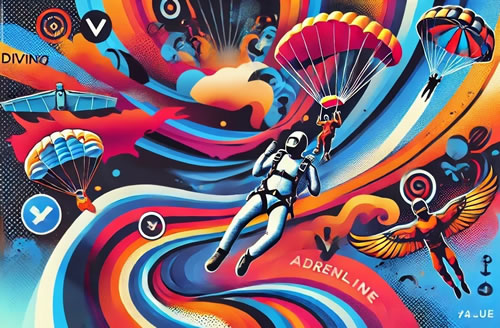
The memory of a tandem skydiving jump, an aerobatic flight, a zipline or a rally ride stays. We talk about it, show it in photos, tell friends about it and relive it in our minds again and again.
And that is why numerous studies confirm that experiences bring more happiness than physical things. A trend that started globally is especially strong in Slovenia — and is replacing the traditional culture of gifting objects.
Why the brain processes experiences differently than objects
When we receive an object, a wave of dopamine — the reward hormone — is released in the brain.
But this feeling fades quickly. After a few days, the thing becomes “normal”. The hands get used to it, the eyes get used to it, the brain adapts. Due to the psychological phenomenon called hedonic adaptation, the object no longer brings happiness.
But with an experience, a completely different process takes place.
1. Emotions imprint deeper than ownership
Experiences include adrenaline, excitement, curiosity, surprise, fear, joy…
These are strong emotions that are stored in long-term memory.
That’s why people still remember exactly how they felt during a skydiving jump even after 10 years — but not necessarily which phone they had at the time.
2. They involve the body, not just the mind
When we physically experience something — wind on the face, speed, movement, the scenery below — it activates several parts of the brain at once.
The more senses are activated, the stronger the memory becomes.
3. Experiences have a natural “story arc”
We remember everything that is part of a story:
- you prepare
- you feel anticipation
- the climax arrives
- then you feel a sense of victory, pride or relaxation
Every good story stays in memory — an experience is one of them.
What science says about why experiences make us happier than things
Several studies from prestigious universities — including Cornell University, Harvard and Yale — show that people often feel more and more lasting forms of happiness with experiences than with the purchase of material items.
One of the most cited series of studies, led by Thomas Gilovich (Cornell University), highlights three key findings:
- Experiences create longer-lasting satisfaction because we relive them in our memory, while material objects quickly become “normal” and lose their novelty.
- They become part of our identity because we talk about them, share them with others and connect them with our life stories.
- They trigger fewer social comparisons than objects — which means fewer feelings of competition or dissatisfaction.
This is also supported by research published in the Journal of Consumer Psychology, showing that experiential purchases increase satisfaction mainly because of the emotional memories and social connection they create.
The common conclusion of the researchers is clear: experiences are more likely to create happiness that lasts longer because they imprint themselves into our memory and relationships, not just ownership.
Key findings:
- Experiences evoke longer-lasting happiness
Because people keep remembering them. - They become part of our identity
We don’t say: “I am a person who owns an iPhone.”
We say: “I am a person who jumped out of a plane.” - We compare objects, but not experiences
With a watch, clothes or a phone, you quickly compare: who has a better one?
With experiences, this almost doesn’t happen. They are unique. - Experiences create connection with others
And social connection is the strongest predictor of long-term happiness.
Why experiences connect people (and why they are the best gift for couples, friends and families)
With physical gifts, the person is alone — they simply receive an object.
With experiences, something special happens: the experience creates a relationship.
- you go together
- you get ready together
- you anticipate together
- you laugh together
- you overcome fear together
- you create a story together that you carry with you
That is why psychologists say that experiential gifts have the strongest effect on relationship quality.
Here all types of experiences come to the forefront:
- tandem skydiving jump
- hot air balloon flight
- paragliding flight
- wind tunnel flight
- bungee jumping
- rally car ride
- aerobatic flight
- zipline
- canyoning
- supercar drive
- scuba diving or snorkelling
- helicopter flight
- ...
Each of these experiences is not just an activity, but a shared moment that you give.
And that is why experience gift vouchers have become one of the most popular choices in recent years — especially among younger generations.
Why physical gifts are losing their appeal
1. Minimalism and owning fewer things
More and more people live in smaller apartments, travel more, and want to avoid accumulating unnecessary objects.
An experience doesn’t take up space — but it stays in the mind.
2. Sustainability
When you give an experience, you don’t create new plastic, packaging or waste. This is one of the strongest trends of 2025–2026.
3. The value of an experience is higher than the value of an object
Even if the price is similar, the subjective value feels completely different.
Example:
- gift: perfume for €70
- experience: zipline or Ferrari ride for €70
What does the person still talk about after 3 months? The perfume? Or the shout “That was insane!”?
How to choose the right experience (a mini guide that works for everyone)
To give the right thing, you need to know the person. That’s why we divide experiences into personality categories:
1. Extrovert — needs action
- skydiving
- rally ride
- aerobatic flight
- bungee jumping
- supercars or formula
- fighter jet flight
2. Adventurer who loves nature
- zipline
- canyoning
- adrenaline descents
- hiking tours
- paragliding flight
- winter ascent of Triglav
- ice climbing
3. A person who loves exploring water
- scuba diving
- snorkelling
- SUP adventures
- rafting
- kayaking
- canoeing
- sailing
4. A person who loves collecting unforgettable moments
- helicopter flight
- panoramic flight
- pilot for 1 hour
- hot air balloon flight
5. Someone who is afraid of heights but wants to try something new
- motocross ride
- karting
- ATV
- archery
- caving
- driving or flying in a simulator
- shooting
- firewalking
Why Slovenians are especially fond of experiences
Slovenia is small but extremely diverse. In less than two hours, a person can go from flatlands to mountains, from mountains to the sea, from a city to a natural park. This compactness is one of the key reasons why Slovenians often choose adrenaline experiences as gifts.
1. Great variety in a small area
In larger countries, you need to travel hundreds of kilometers for a skydive, panoramic flight or zipline. In Slovenia, all of this is practically around the corner.
Examples:
- skydiving — Maribor, Šentvid pri Stični, Lesce, Murska Sobota, Bovec, Ptuj, Portorož
- panoramic flights — all over Slovenia
- zipline — Bovec, Planica, Maribor, Radovljica
- rally rides — several locations in the region
- canyoning — Bovec, Bohinj, Bled, Logarska Dolina
- supercar rides — Koper, border locations in Croatia, Italy and Austria
This variety allows people to see experiences as a realistic and easily accessible gift, not as something “too far” or “too complicated”.
2. Strong connection with nature
Slovenians love hiking and living close to forests, rivers and mountains. A gift that includes nature is always well received.
3. The value of personal experiences (over objects)
Younger generations (18–45) buy fewer physical objects. They prefer to buy stories — and experiences are exactly that.
Why giving an experience means giving a story
Psychologists say that people connect their identity most strongly with memories, not with things. When you give a person an experience, you are giving them something that will:
- stand out from their routine
- break their everyday life
- leave a mark in their mind
- change their view of life (sometimes forever)
And here is another important point:
There is no right or wrong time for an experience
Perfume can “not suit”.
A shirt can be “not the right style”.
A watch can be “too big”.
An experience is always well received.
If the date doesn’t fit, the person simply reschedules it.
If they change their mind, they exchange it for another experience.
An experience is not limited by color, size, taste or fashion trends.
Why Xsport represents the best example of modern experience gifting
An example of why Xsport perfectly follows the trend of modern gifting.
1. The largest selection of adrenaline experiences in Slovenia
Extremely important for the gift buyer:
More choice = easier decision.
This means the gift suits everyone: couples, friends, families, young people, experienced adrenaline lovers and complete beginners.
2. The ability to exchange all vouchers
This is psychologically very important.
If someone receives a gift that doesn’t suit them — they can exchange it.
This flexibility reduces stress when choosing and increases the value of the gift.
3. Long validity and the possibility of extension
Another huge advantage over physical gifts:
The gift does not “expire” because it can be extended.
Objects lose value over time, but an experience stays available.
4. We are not intermediaries — we perform experiences ourselves or work with reputable and verified instructors
This builds trust. The recipient understands that a real team, professionals and licensed instructors stand behind the experience.
5. Experiences for all budgets
- from €20–40 (zipline, karting,...)
- from €200–500 (supercars, flying,...)
- premium high-end (aerobatic flights, military aircraft, helicopter,...)
This means the gift is budget flexible, which is crucial today.
6. A strong sense of safety and professionalism for customers
When it comes to adrenaline experiences, this is essential.
Clear descriptions, locations, safety procedures, certificates — all of this reassures both the buyer and the recipient.
What will gifting look like in the future?
If we look at trends in Europe and the USA, the direction is clear:
✔ fewer objects
✔ more experiences
✔ more personalized gifts
✔ more services and fewer physical products
✔ more emphasis on relationships, connection and stories
Generation Z and younger millennials see experiences as a currency of memories.
By 2030, more than 55% of all gifts in Europe are expected to be based on services, courses and experiences — not objects.
Slovenia follows this trend very quickly, perhaps even faster than larger markets.
For memories that last
When we give a person an object, we give them something they can hold.
But when we give them an experience, we give them something they can feel, live through, store in their heart — and carry with them for life.
Science says that experiences are the best investment in happiness.
Psychologists say they are the best gift for relationships.
Life shows that they are the best way to create memories that do not fade.
In a world full of things, experiences are what truly define us.
And that is why experiences are replacing traditional gifts.
Because they are not just something you give.
They are something that remains.


