

Skydiving in Bovec: Freefall above the Soča Valley and the Julian Alps
0%

Most visitors know Bovec for the emerald Soča River, majestic mountains and numerous outdoor adventures. However, you can also experience this picturesque Alpine valley from a completely different perspective – during a freefall from an altitude of 4,000 metres.
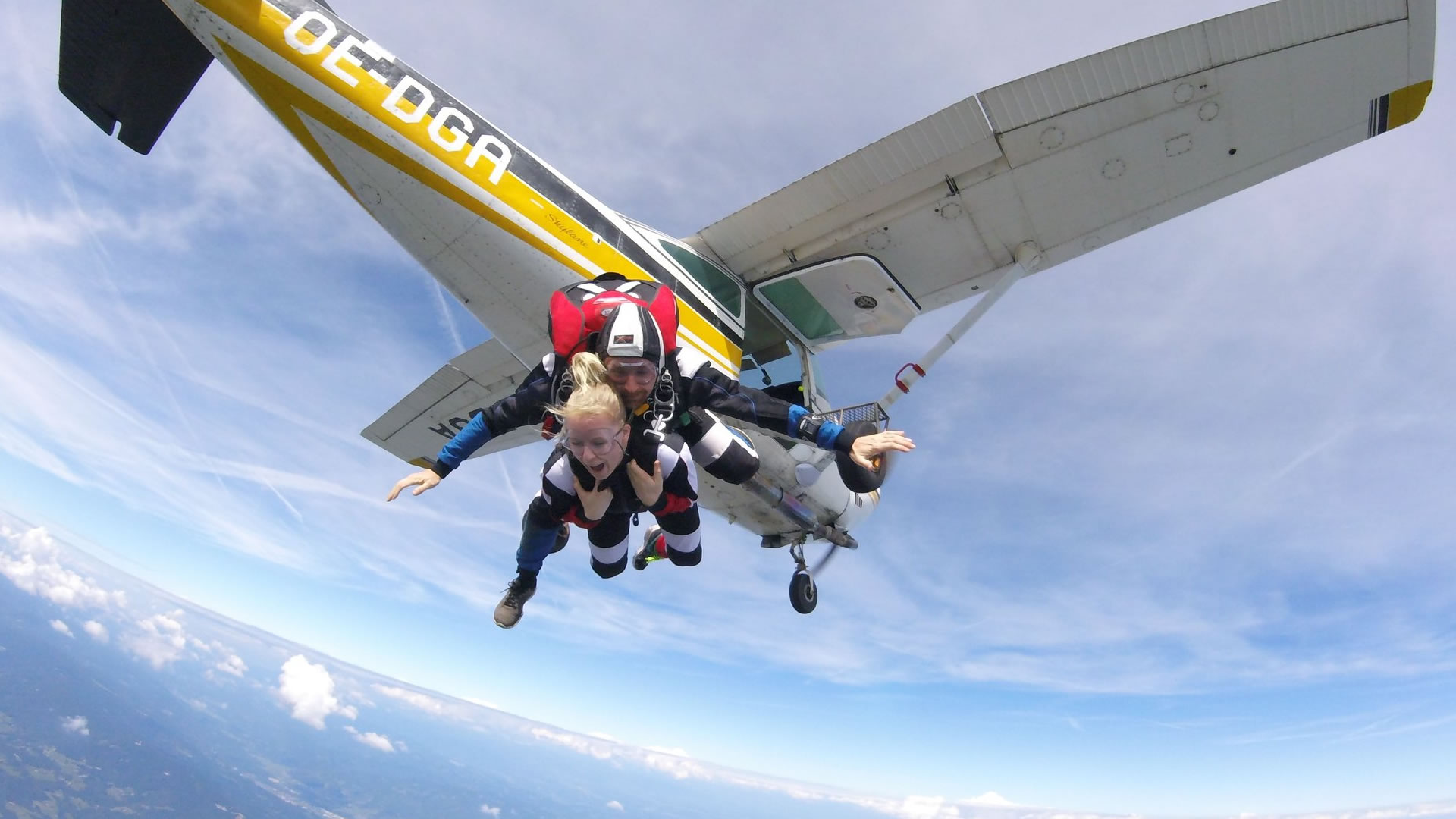
Tandem skydiving in Bovec combines an intense adrenaline experience with views of one of Slovenia’s most beautiful landscapes. As the aircraft climbs, the Soča Valley, the surrounding peaks and the rugged terrain of the Julian Alps gradually open up beneath you. Then the aircraft door opens and the moment you came for arrives: stepping out into the void and almost a full minute of freefall.
You do not need any skydiving knowledge or previous experience for a tandem jump. Throughout the experience, you are securely attached to our experienced tandem pilot, who takes care of the preparation, exit from the aircraft, parachute deployment, steering during the descent and landing. Your main task is to follow the brief instructions and make the most of the experience.
If you are considering your first jump, you are probably wondering how everything works, what freefall feels like and whether being afraid of the jump is normal. Let us take a look at what awaits you during a tandem skydive in Bovec.
Why is skydiving in Bovec so special?
A tandem skydive can be completed at various locations, but the surroundings have a significant influence on the overall experience. A jump in Bovec is not only about the altitude, speed and freefall. The extraordinary Alpine scenery is also an important part of the experience.
The Bovec Basin is surrounded by high mountains, while the distinctive Soča River flows through the valley. Even during the flight to the jump altitude, you can watch the landscape below gradually become smaller. Roads turn into thin lines, houses into tiny dots and the entire valley opens up before you.
The view from the aircraft is already a panoramic experience in itself, but the real change of perspective happens after the exit. During freefall, you travel at a speed of around 200 kilometres per hour, so you do not observe the landscape in the same way as during a conventional panoramic flight. The sensation is intense, loud and full of stimuli.
Everything changes once the parachute opens. Your speed decreases considerably, the roar of the wind disappears and you suddenly have time to look around. The valley stretches out beneath you, the mountains rise in front of you and you glide calmly towards the landing area for several minutes.
This transition from powerful freefall to a peaceful parachute descent is one of the most fascinating parts of the entire jump.
You do not need experience for your first jump
A tandem skydive is intended for people who want to experience freefall without having to complete a skydiving course beforehand. The participant wears a special tandem harness and is connected to the tandem pilot at several points throughout the jump.
The tandem pilot takes care of the technical aspects of the jump, so you do not need to know how to control a parachute, assess altitude or plan the landing. Before take-off, you receive clear instructions that mainly cover your body position during the exit, your posture during freefall and the position of your legs before landing.
The preparation is simple enough for someone encountering skydiving for the first time to remember. Nevertheless, it is important to listen carefully to the instructions and follow them during the jump.
Most tandem skydiving participants have never jumped from an aircraft before arriving. Feeling nervous is therefore nothing unusual. In fact, the anticipation is often a more difficult part of the experience than the jump itself. Once you leave the aircraft, there is usually not much time left to think about fear.
How does skydiving in Bovec work?
The entire experience, including registration and preparation, usually takes approximately two hours. Since the activity depends on the weather, air traffic and the organisation of that particular day, it is advisable not to plan an overly tight schedule.
Arrival and registration
You arrive at the location at the agreed time. After registration, you are introduced to the course of the activity and wait while your group or flight is prepared.
The waiting time may depend on the current conditions. Skydiving is an activity in which wind, cloud cover, visibility and other weather conditions play an important role. Even if the weather appears pleasant on the ground, suitable conditions must also be present at different altitudes.
Meeting the tandem pilot and preparing for the jump
Before the jump, you meet our tandem pilot, who will complete the jump with you. You receive the necessary equipment and a special harness, which the staff adjusts properly to your body.
A short preparation session follows. The tandem pilot shows you which position you need to adopt when exiting the aircraft, how to hold your arms during freefall and what to do before landing.
This is not a long or demanding course. The instructions are practical, easy to understand and focused on the things you will actually need during the jump.
Flight to an altitude of 4,000 metres
Once you are ready, we board the aircraft together with the other participants and skydivers. During the climb, you are already connected or become fully connected to the tandem pilot, who checks all the equipment once again.
The flight to the jump altitude takes some time, allowing you to observe Bovec and its surroundings during the climb. At first, you can recognise individual buildings, roads and the river, before a broader view of the valley gradually opens up in front of you.
The atmosphere inside the aircraft is usually a mixture of excitement, anticipation and slight tension. As you approach an altitude of 4,000 metres, it becomes clear that the moment of the jump is rapidly approaching.
Exiting the aircraft
When the door opens, the sound and atmosphere inside the aircraft suddenly change. The tandem pilot guides you towards the exit, checks your position and ensures that you leave the aircraft at the correct moment.
The exit is the part that many people look forward to the most before the jump while also fearing it the most. In reality, everything happens very quickly. There is no long period of hanging at the edge or waiting while you have to gather the courage yourself. Since you are attached to the tandem pilot, you exit the aircraft together.
The first few moments are difficult to compare with any everyday experience. Your body and brain try to understand what is happening, after which your position stabilises and the true freefall begins.
What does freefall feel like?
People often expect freefall to cause the same unpleasant sensation in the stomach as a rapid drop on a roller coaster. However, the feeling is usually different.
When jumping from an aircraft, you are not falling along a track and are not enclosed in a seat. After the initial acceleration, air resistance gradually balances your fall, creating the sensation that you are lying or floating on a powerful stream of air.
The wind is loud and the air pressure is strong, but you can breathe normally. The freefall speed during a tandem jump is approximately 200 kilometres per hour, but because of the altitude and the absence of nearby objects, you do not perceive the speed in the same way as when travelling by car.
During a jump from an altitude of 4,000 metres, the freefall lasts almost a minute. On paper, a minute may not seem like much, but an enormous amount happens during that time. The initial surprise is usually followed by excitement and the realisation that you are actually freefalling above Bovec.
If you order a recording, this is the part in which footage of your most genuine reactions will be captured. During freefall, it is almost impossible to perform for the camera. Your face very quickly reveals whether you are surprised, excited or simply unable to believe that you have really jumped.
What happens after the parachute opens?
At the appropriate altitude, the tandem pilot deploys the main parachute. The transition from freefall to descending under an open parachute is noticeable, but it does not involve the sudden and painful jolt that some people imagine.
After deployment, the position and operation of the parachute are checked first. This is followed by a panoramic descent lasting several minutes towards the landing area.
This is the moment when you can calmly observe your surroundings. After the intensity of freefall, the silence beneath the open parachute is almost surprising. You can talk to the tandem pilot, look towards the mountains and observe the Soča Valley from a perspective that cannot be experienced from the ground.
Depending on the conditions and the course of the jump, the tandem pilot may also show you how the parachute responds when turning, and you may complete a few spiral turns together. The intensity of the descent is always adjusted to the circumstances and the participant’s well-being.
As you approach the ground, the pilot explains the landing position once again. At the correct moment, you usually need to lift your legs, while the pilot takes care of everything else.
Is the landing hard?
Fear of landing is very common, particularly among people who have never seen a tandem skydive up close. They imagine a powerful impact with the ground or running at high speed, but the landing is generally considerably calmer.
Tandem parachutes are designed for two people and allow for a controlled final approach. Before touching the ground, the pilot reduces the parachute’s speed and determines the landing method based on the wind and the conditions in the landing area.
The participant primarily needs to follow the instructions regarding the position of their legs. The landing often ends with a gentle slide across the grass, while under certain conditions you may also land on your feet.
The landing is also the moment when the initial adrenaline begins to turn into excitement. Immediately after touching the ground, many participants find it difficult to describe what they have just experienced. Laughter, cheers and questions about whether they can go again are common.
How should you prepare for a tandem skydive?
You do not need any special sports equipment for the jump, but it is important to arrive appropriately dressed and well rested.
Choose comfortable clothing that allows you to move normally. Sportswear suitable for the temperature on the day of the jump is appropriate. Remember that it is colder at altitude than it is on the ground.
Wear sports shoes with flat soles and laces. Flip-flops, sandals, high-heeled shoes and other footwear that could come off are not suitable for the jump.
If you have long hair, bring a hair tie. Jewellery, large earrings, loose accessories and objects in your pockets are best removed before the jump.
Prescription glasses are generally not an obstacle either. Special skydiving goggles can be fitted over them. You can wear contact lenses as usual, but always follow the instructions provided by the staff at the location.
Before arriving, eat a normal, lighter meal and drink enough water. Jumping on a completely empty stomach is not the best decision, while very heavy or fatty food should also be avoided immediately before the activity.
Consuming alcohol or other intoxicating substances before the jump is not permitted.
What happens in bad weather?
Tandem skydives are only carried out in suitable weather conditions. Strong winds, storms, precipitation, low cloud cover or poor visibility may cause the jump to be delayed or rescheduled.
This does not mean that the sky must be completely cloudless. The decision depends on the specific conditions and the professional judgement of our skydiving team.
Sometimes the weather improves after only a short wait, so it is advisable to allow some extra time on the day of your jump. If the jump cannot be completed safely, it is rescheduled for another available date.
Although rescheduling can be inconvenient, the correct decision in skydiving is always the one that prioritises safety. Suitable conditions not only ensure a safer jump, but usually also provide a more pleasant freefall, a calmer descent and better views.
Is it worth ordering a recording of the jump?
Skydiving is a very intense experience. Everything happens quickly and there are so many impressions that you may not remember some moments precisely after landing. This is why many participants choose photography or video recording.
With hand-camera recording, the camera is attached to the tandem pilot’s hand. This method captures your face, reactions and the action immediately around you during the jump particularly well.
With external recording, an additional skydiver jumps with you and follows you during freefall. The footage therefore shows a broader perspective, including the exit from the aircraft, the freefall and the Alpine surroundings around you.
For safety reasons, you cannot use your own camera or telephone during the jump. If you would like footage, you need to select one of the recording options available when placing your order.
The video is not only a memory for the participant. It allows you to show the experience later to family and friends, who may be able to watch your jump from the ground but cannot see the freefall up close.
A tandem skydive in Bovec as a gift
Skydiving is suitable for people who value experiences more than conventional material gifts. It is often given for milestone birthdays, graduation from school or university, anniversaries or as a joint gift from a group of friends.
The advantage of a gift voucher is that the recipient does not need to jump immediately. They can book the date later and adjust it according to availability and their own schedule.
Before purchasing, it is nevertheless advisable to check the basic participation requirements, particularly the age and maximum permitted weight. This helps you avoid giving someone an experience they would be unable to use because of the restrictions.
If you are unsure whether the person really wants to jump, you can assess their interest through a more general conversation about adrenaline experiences. On the other hand, the surprise itself is often part of the appeal of such a gift.
The voucher is valid for one person, while spectators can come along and watch the jump from the activity area. This means you can turn the visit to Bovec into a shared excursion, even if only the birthday celebrant jumps from the aircraft.
Fear before the jump is normal
Almost every participant feels at least some fear before their first jump. Some people become nervous several days beforehand, while others remain relaxed until the moment the aircraft door opens.
Fear does not mean that you are unsuitable for the jump. It mainly means that you understand how unusual it is to decide to leave a functioning aircraft at an altitude of 4,000 metres.
It helps to focus on the individual steps. First comes the arrival, followed by preparation, boarding, the flight and only then the jump. Listen to the tandem pilot and do not try to control every moment in advance.
A tandem skydive is designed so that the technical aspects are handled by a trained pilot. When the moment of exit arrives, you trust the pilot, adopt the agreed position and surrender yourself to the experience.
After landing, most people realise that the anticipation was far more frightening than the freefall itself.
Bovec from a perspective you will never forget
Bovec offers numerous ways to explore the Soča Valley, but the view from an altitude of 4,000 metres is something completely different. A tandem skydive combines a panoramic flight, almost a minute of freefall and a peaceful parachute descent above the Alpine landscape.
From the first glance towards the open aircraft door to the moment when you are standing on solid ground again after landing, it is an experience filled with powerful and very different sensations.
First comes the anticipation. This is followed by the intense exit from the aircraft, the speed of the freefall and the wind against your face. Once the parachute opens, there is silence, a view of the valley and a gradual approach towards the ground. In the end, what remains is relief and the feeling that you have done something you may not have believed you would dare to do only a short time ago.
If you would like to experience freefall above the Soča Valley and the Julian Alps, tandem skydiving in Bovec is an opportunity to discover one of Slovenia’s most beautiful landscapes from a completely new perspective.

Recent Posts


